Amazon ranks 49th of 1,204 sources — 16,533 citations across 99 products in 10 categories.
When AI assistants recommend products, they draw from independent review sites, lab testing and video. Amazon, the world's largest store, ranked 49th — cited in just 0.4% of answers.
When you ask ChatGPT, Claude or Perplexity to recommend a product, they build the answer from independent review sites and video — not from marketplaces. Across 99 products in 10 categories, we counted all 16,533 citations across 1,204 distinct sources. YouTube ranked first with 1,540 citations; Amazon — the world's largest store — ranked 49th with just 63 (0.4%). Every marketplace combined accounted for 3.6%. To be recommended by AI, a product has to exist on the sites AI trusts, not only on its marketplace listing.
Where AI's product recommendations actually come from
We logged every source ChatGPT, Claude and Perplexity cited as they recommended products — 16,533 citations spanning 1,204 distinct sources. Ranked by citation count across all 99 products — top 12 shown. The only two marketplaces to appear (Best Buy, Amazon) are the two shortest bars:
Citations across 99 products × 10 categories × 3 engines (ChatGPT, Claude and Perplexity). Top 12 of 1,204 sources shown. June 2026.
The AI shelf is independent reviewers, not the marketplace
Sort every citation by the kind of site it lands on and the picture is stark. Independent review sites and community video do the work; marketplaces — where every one of these products is actually sold — barely register.
Share of 16,533 citations by source type · 99 products · June 2026. “Other specialist sites” are review blogs not yet hand-classified into editorial, so the independent-reviewer share is a floor.
Every place you sell — and how rarely AI cites it
These are the marketplaces and big-box retailers AI cited at all, with their rank out of 1,204 sources. The highest, Best Buy, sits at #14; Amazon at #49.
Citations to each marketplace / big-box retailer · global rank in brackets · June 2026.
Where to win — the source AI trusts in each category
The shelf isn't the same in every aisle. Each category has its own set of sources AI reaches for first — and almost none of them are marketplaces. This is the map a seller acts on: the top three sources AI cited in each of the 10 categories we studied.
Top 3 most-cited sources per category · 99 products · June 2026.
What this means for your product
AI discovery is winnable — but the work happens off the marketplace. Based on the data, the highest-leverage moves:
- 1Earn independent reviews.Get your product tested and listed by the sites AI cites — RTINGS, Consumer Reports, OutdoorGearLab and your category's specialist. That's the recommendation layer, and it's where 64.8% of citations land.
- 2Win on YouTube. Creator reviews and round-ups feed the single most-cited source of all (1,540 citations). Seed your product to the reviewers in your niche.
- 3Target your category's kingmaker.Each aisle has a site AI turns to first — Mattress Nerd for mattresses, VacuumWars for robot vacuums, RunRepeat for running shoes. Use the map above and go where your buyers' AI is already looking.
- 4Don't mistake marketplace rank for AI visibility. A best-seller badge barely registers — marketplaces are 3.6% of citations. Optimising only your Amazon listing leaves you invisible to AI discovery.
How we ran this
We probe the AI assistants shoppers actually use with the questions shoppers actually ask, then record which sources each model cites. This report aggregates that data across 10 high-consideration product categories.
- Prompts
- The questions shoppers actually ask — “best [category]”, “[product] vs alternatives”, “is [product] worth it” — run in web-grounded mode. We logged every source each model cited while forming its recommendation. Each product was probed with 12 shopper-style prompts per engine. Each prompt was run once (single-pass; figures are directional at scale, not averaged over repeated runs).
- What “cited” means
- A source the model drew on to decide what to recommend — not“where to buy”. Retail links appear, but they’re a small fraction of the recommendation-authority sources we count. That distinction is the whole point of the Amazon finding: Amazon is where shoppers buy, not where AI learns what’s worth recommending.
- The set
- 99 products × 10 categories × 3 engines (ChatGPT, Claude and Perplexity). 16,533 citations across 1,204 distinct sources. Categories: wireless earbuds, robot vacuums, air fryers, standing desks, creatine, mechanical keyboards, electric toothbrushes, portable power stations, memory foam mattresses and road running shoes — chosen as high-consideration purchases where buyers research before they buy.
- How sources are grouped
- Each domain is classified as a marketplace, an independent review site (editorial), community (YouTube/Reddit), a manufacturer's own site, or other. The marketplace figure is exact. Editorial and manufacturer shares are reported as a floor: ~25% of citations sit in “other” specialist review blogs not yet hand-classified, almost all of which are independent reviewers — so the true independent share is higher than 64.8%, never lower.
- Excluded
- Google Gemini (its redirected citation URLs defeat clean domain attribution) and Amazon's Alexa for Shopping / Rufus (no public API). Any figures we publish for it elsewhere are a separate, clearly-labelled simulation and are never blended into these counts.
- Filtered
- Spam/dead domains removed; only the 10 studied categories are counted (non-category noise dropped).
- Dated
- June 2026. AI answers shift run to run; figures are frozen on publish and re-locked with a dated note as the dataset grows.
- Reproduce it
- Run the same prompts in web-grounded ChatGPT, Claude or Perplexity — the same kinds of sources surface. The per-category source leaders are checkable in minutes.
Share the findings
All six graphics are free to republish with credit to MrPrime and a link back to this report. Click any graphic to open it full-size, then save or embed.
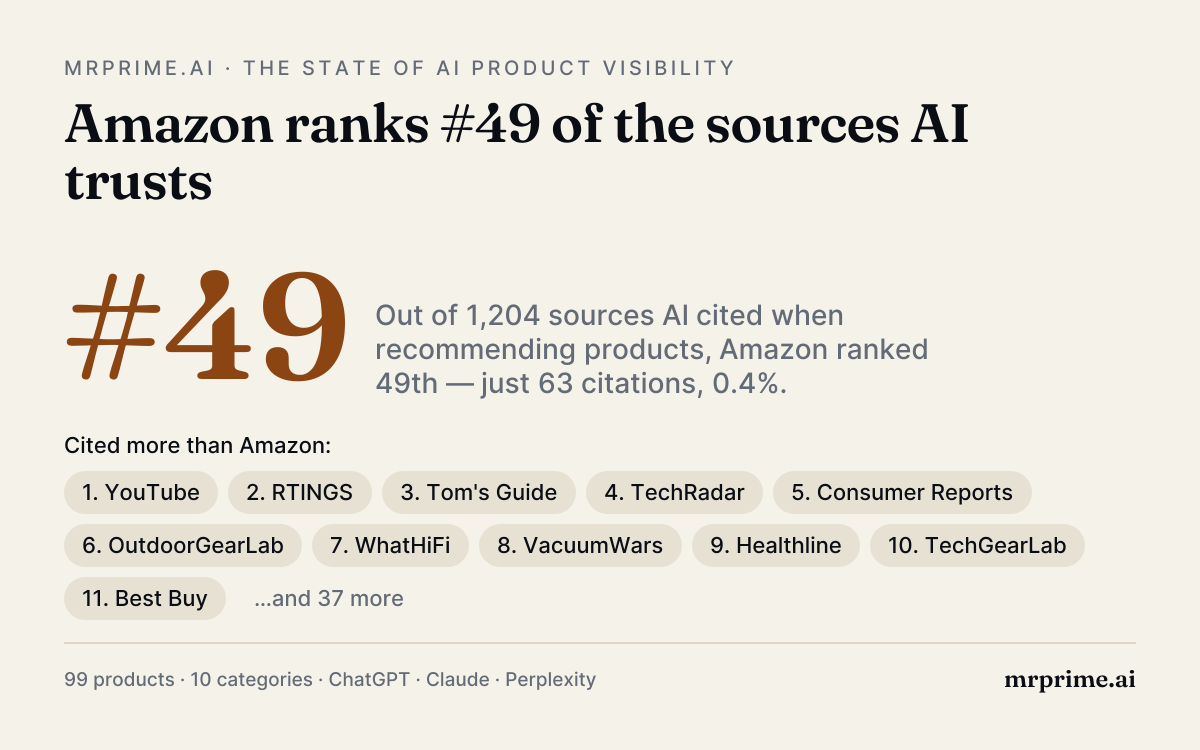 Amazon ranks #49 of 1,204 sources
Press enquiries and the full dataset: mrprime.ai.
Frequently asked
How does AI decide which products to recommend?
It doesn't read your Amazon listing — it assembles an answer from sources it trusts. Across 99 products and 16,533 citations, the dominant sources were YouTube (1,540 citations), RTINGS (856) and Tom's Guide (730). A product that's well represented on independent review sites is far more likely to be named than one that exists only on a marketplace listing.
Does Amazon matter for AI product recommendations?
Far less than most sellers assume. Across 99 products, three AI engines cited Amazon just 63 times — ranking it 49th of 1,204 sources, 0.4% of all citations. Every marketplace combined (Amazon, Best Buy, Walmart, Target, GNC…) accounted for just 3.6%. Amazon is where shoppers buy; it is not where AI learns what to recommend.
How do I get my product recommended by ChatGPT?
Earn placement on the sources AI cites: independent review sites (RTINGS, Consumer Reports and your category's specialist site), strong YouTube review coverage, and editorial round-ups. The per-category map above shows the exact sites AI reaches for in each of the 10 categories. See the four-step checklist.
Which AI models were tested?
ChatGPT, Claude and Perplexity, all with live web access. We excluded Google Gemini (its redirected citations defeat clean source attribution) and Amazon's Alexa for Shopping / Rufus (no public API — any figures we run there are a separate, clearly-labelled simulation, never blended into these numbers).
Can I see how AI sees my own product?
Yes. MrPrime runs the same shopper probes against your specific product and category, and shows which engines name it, at what position, and which products win instead.
See how AI sees your product
We ask the assistants what shoppers ask — and show you exactly where your product stands, which sources name it, and how to climb.
Check your product's AI visibility →Figures from the 99-product / 3-engine dataset (ChatGPT, Claude and Perplexity), June 2026. Drawn from our live citation data and re-locked with a dated methodology note as the dataset grows. Not affiliated with or endorsed by OpenAI, Anthropic, Perplexity, Google or Amazon.